Snows of Kilimanjaro, The (1952)
Snows of Kilimanjaro, The (1952), directed by Henry King.
This was well-liked at one time for the story and stars. The big soap opera genre is not as popular these days and Hemingway's blood sports like big game hunting and bull fighting are out of fashion.
Still: it has those stars and is in Technicolor, so attention must be paid.
Hemingway's short story is loosely autobiographical and the film is a reasonable adaptation. They add an additional romantic character and give it a Hollywood ending.
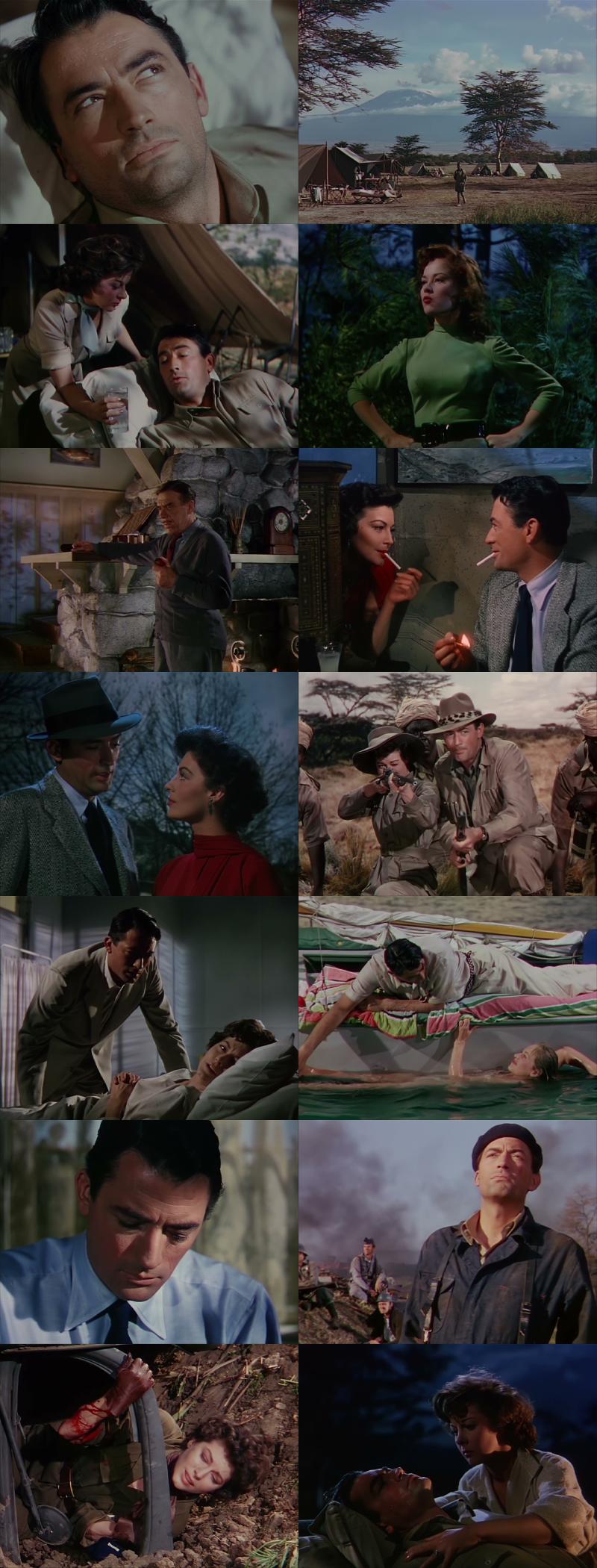
Harry Street (Gregory Peck) is at his Africa hunting camp, dying of an infected leg. He drinks and drifts into memories. He had adventures but his story is staged as acts with the women in his life.
He always wanted to be a writer, all other considerations secondary. He had success but it was hard on others in his life. He is rather unlikable.
We briefly see the last night of his youthful romance with Helene Stanley. I always have to tell her story: she was the rotoscope model for animated Disney princesses, was a key dancer in Asphalt Jungle, The (1950) and for two years was married to gangster Johnny Stompanato, who was once knocked down by Sean Connery and later killed by Lana Turner's teenage daughter.
In Paris Harry meets Cynthia Green (Ava Gardner), the great love of his life. He neglects her, the dope.
He becomes engaged to the Countess (Hildegard Knef) but can't get over Cynthia, who he finds dying under an ambulance in the Spanish Civil War.
His final love is Susan Hayward who is with him in Africa at the end. He has settled for her and she knows it, but is tough enough to cope with him.
In the story he dreams that a rescue plane takes him over the mountain where the body of a leopard was described earlier. We presume he died while dreaming. The movie makes the rescue real, which is artistically too bad.
We have well known supporting actors: Leo G. Carroll, Torin Thatcher and Marcel Dalio.
Some location shooting in Africa and on the Riviera.
Score by Bernard Herrmann.
Photographed by Leon Shamroy:
Available on Blu-ray as a Film Masters BD-R, an upscale with quite a lot of noise reduction smearing. The film is in the public domain.