Ulysses (1954)
Ulysses (1954), directed by Mario Camerini.
The Odyssey is being much discussed as I write this because of Christopher Nolan's 2026 film. I will get around to seeing it, but until then I've been watching other Homeric cinema.
Troy (2004) seems better now than it did at the time, despite deviations from the text. To be fair, the film is not called The Iliad.
Ralph Fiennes' The Return (2024) is a leisurely account of the last part of the story. At age 62 his musculature is impressive.
I'll try Helen of Troy (1956) again, although I remember it being dull.
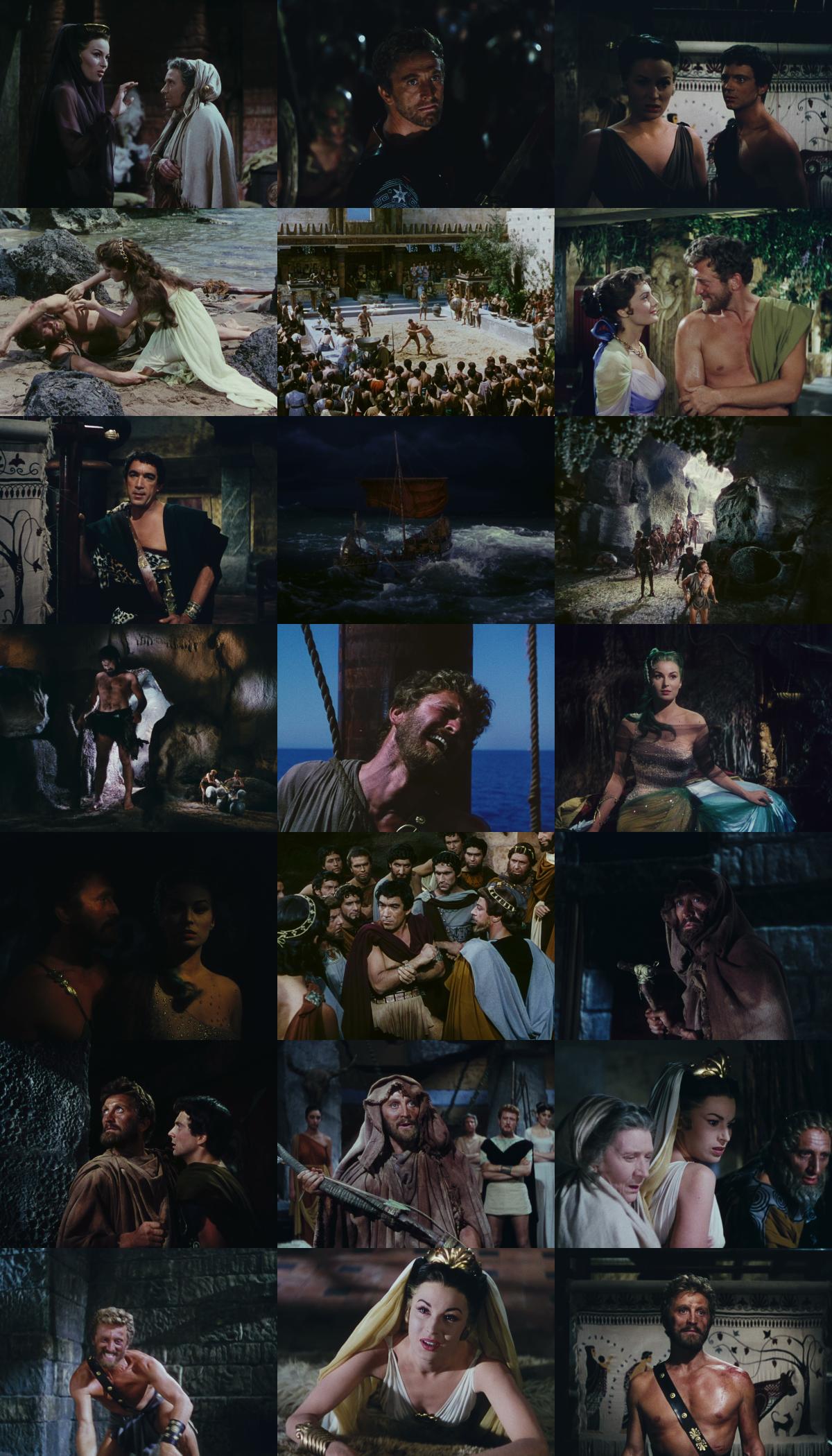
Here we have Kirk Douglas as the long absent King of Ithaca, ten years at war and ten more trying to get home. For the wily "man of craft" he doesn't do much planning ahead. His adventures aren't getting him closer to his goal.
Douglas reminds me of Charlton Heston in that he often seems stuck on intense which is a poor contrast to the stiff performances around him. Like Heston, he likes stripping off his clothes. As does Ralph Fiennes in his movie.
Silvana Mangano plays both Penelope and the witch Circe. She's lovely and is also the wife of producer Dino De Laurentiis. She's mostly statuesque, although she makes Circe spooky just from posture and looks.
Anthony Quinn is the most aggressive suitor. Born in Mexico he had success in American films but became world famous in Italian cinema.
Rossana Podestà, Nausicaa here, will soon play the title character in Helen of Troy (1956).
The conceit here is that Odysseus/Ulysses has washed up on Nausicaa's island but has amnesia. Through recovered flashbacks we get the episodes of his journey.
It's been a while, but I don't recall that from the text. Odysseus just lies about his history.
(When I was young the popular translations were Lattimore and Fitzgerald. More recently I have an audiobook reading of Fagels performed by Ian McKellan. I've told people it's like Gandalf reading classics to you, but his voice is younger and doesn't have the wizard's gravel).
We have:
Quick shots of the Horse and the sack of Troy.
The cave of Polyphemus. Somehow they get him drunk on grape juice.
The Sirens with our hero tied to the mast. He hears his wife's voice and believes he is home. "The gods are cruel" he later says.
A year with Circe and the loss of his crew. (He started with ten ships, then had one, then none).
Rather than visiting Hades, Circe summons up the spirits of his old friends who advise him to stay put. We might think she is deceiving him, but the spirit of his mother appears and tells him to get going.
We omit the seven years on Calypso's island. From the text I remember her bitterness when Hermes tells her it is time to let him go: "You gods..." (See also Suzanne Vega's "Calypso").
He appears on Ithaca dressed as a beggar. His old dog remembers him. In the text his nurse recognizes a scar on his foot.
He reveals himself to his son and they plot the death of the suitors. He easily strings the bow, shoots through the axe heads and commits mass slaughter.
If you see someone string the bow of Odysseus and all the doors are locked, there is only brief time left to reflect on your life choices.
The arrangement of the axe heads in The Return (2024) follows this film closely.
Photographed by Harold Rosson:
Available on Blu-ray from Kino. The image is a fine upgrade from the dismal DVD I had before. The audio is poor, but that's Italian cinema of the period. The disc includes both English and Italian versions; I watched the Italian.
Tim Lucas provides an audio commentary. He discusses the movie itself, but mostly gives detailed background on everyone involved. Lots of "lives and loves" of movie makers, and details of a particularly troubled "too many cooks" production.